War Thunder: a plain guide to the vehicles, the classes and the multiplayer
Written by the editorial team at Bacidia s.r.o. · Published 16 September 2026 · Last reviewed 16 September 2026
Advertising disclosure. This page is commercial. Links and buttons marked partner link send you to a third-party partner, and if you register through one we may be paid a commission at no extra cost to you.
We are not Gaijin. aethervane.online is published by Bacidia s.r.o. and is not affiliated with, endorsed by or sponsored by Gaijin Entertainment, the developer and publisher of War Thunder. This is an independent guide. For official information, downloads and support, go to the publisher's own website.
The game itself is free to download, and it also sells optional in-game items and premium accounts. Those purchases are made on the publisher's platform, never on this site. We never ask you for payment details.
War Thunder is one of the best-known free-to-play military vehicle games. This guide walks through the vehicle classes you will actually meet, what each one is for, how the multiplayer modes and matchmaking work, what the game costs, and how to get started. It is written for someone who has never installed it.
What War Thunder is
War Thunder is a large online combat game developed and published by Gaijin Entertainment. It puts you in the cockpit, the commander's seat or the bridge of hundreds of real military vehicles across three branches: ground vehicles, aircraft, and warships. The roster runs from the interwar years through the Second World War and the Cold War into modern equipment.
The game is free to download and play. You start with a small number of entry-level vehicles in each branch and earn research points and in-game currency by playing, which unlocks the rest of a nation's tech tree. Vehicles in the tech trees are obtainable through play. The game also sells premium vehicles and a premium account, both of which increase the rate at which you earn — so money buys progress faster, not a vehicle you could never otherwise reach. Whether that trade feels fair is a judgement you will have to make for yourself; we are not going to make it for you.
Matches are played online against other players. A standard ground, air or naval battle is built for 32 players, 16 on each side. Some large-scale air Simulator sessions run bigger. You can queue alone or bring a squad.
Vehicle classes
Each branch has its own progression tree per nation, and within a branch the classes play very differently. Below is what you will actually find in the game, rather than what a war film might lead you to expect.
Ground vehicles
- Light tanks — fast, thinly armoured, used for scouting, capturing points and flanking.
- Medium tanks — the backbone of a line-up: a workable balance of armour, gun and speed.
- Heavy tanks — thick armour, slow, used to hold ground and absorb fire.
- Tank destroyers — a big gun on a light hull, often with no rotating turret. Built to kill tanks from cover.
- Self-propelled anti-aircraft (SPAA) — rapid-fire guns or missiles that clear enemy aircraft and helicopters off your team.
- IFVs and light armoured vehicles — autocannons and anti-tank missiles on a mobile chassis.
There is no playable infantry in War Thunder. You always command a vehicle.
Aircraft
- Fighters — fast and agile, built for air-to-air combat.
- Strike aircraft — carry bombs, rockets and guided weapons against ground targets.
- Bombers — heavier payloads aimed at bases and ground objectives, at the cost of manoeuvrability.
- Multirole jets — later-generation aircraft that do both jobs adequately.
- Helicopters — attack and utility helicopters with missiles and rockets; their own branch of the tree.
Warships
- Coastal craft — motor torpedo boats, gunboats and sub-chasers. Small, quick, fragile.
- Destroyers — the first proper warships: torpedoes, dual-purpose guns, decent speed.
- Light and heavy cruisers — more armour and heavier main batteries for mid-range gunnery.
- Battlecruisers and battleships — the heaviest vessels at the top of the bluewater tree, with long-ranged main guns and thick belt armour.
Aircraft carriers and submarines are not player-controlled vessels in War Thunder. Carriers appear on some maps as an object you can take off from and land on.
Tactics by class
Each class has a job. Playing a vehicle against its job is the most common reason new players lose matches quickly.
Light tanks should use speed to scout, mark enemy positions and hit from the side. They should not trade shots head-on with anything heavier. Medium tanks hold the line: take a useful position, support the lighter vehicles, trade at medium range. Heavy tanks work as a shield — they draw and soak fire while the rest of the team works the flanks. Tank destroyers belong at long range, behind cover, firing before the enemy can close. SPAA is not a spare tank: park it where it can see sky, and kill the aircraft that would otherwise farm your team.
Fighters live on energy management: climb, keep height in reserve, dive on a target, and use the speed you gained to leave rather than to turn. Strike aircraft should approach at the edge of enemy air defence, release in a short pass, and turn away immediately. Bombers want altitude and a straight run-in, and should expect to be hunted. Helicopters attack from unexpected angles and are badly exposed to SPAA — stay low, use terrain, and do not hover in the open.
Coastal boats use speed and the coastline: close fast, launch torpedoes, break away. Destroyers screen the fleet, use torpedoes at range and keep their anti-air guns busy. Cruisers hold the middle distance and can take a hit. Battlecruisers and battleships hit hardest and furthest, but they turn slowly and every torpedo on the map has their name on it.
Multiplayer modes
The same vehicles are played under three difficulty settings, plus a competitive mode. The difficulty you pick changes the aids you get, not the content.
- Arcade Battles — the forgiving setting: aiming aids, visible enemy markers, shorter matches. Standard lobbies are 16 v 16.
- Realistic Battles — fewer aids, real ballistics and damage, one aircraft or one vehicle at a time from your line-up. Standard lobbies are 16 v 16.
- Simulator Battles — cockpit view, minimal interface, full flight or driving model. Large air Simulator sessions (Enduring Confrontation) run longer and hold more players than a standard lobby.
- Squadron Battles — the competitive mode, played by squadrons in small fixed-size teams.
Team sizes, modes and events change with game updates. Check the publisher's official patch notes for the current numbers.
Squads & matchmaking
You can play alone or in a squad. A squad is a small group — up to four players in the usual modes — that queues together and is placed on the same side. Larger, permanent groups are called squadrons; they play Squadron Battles together and pool research towards squadron vehicles.
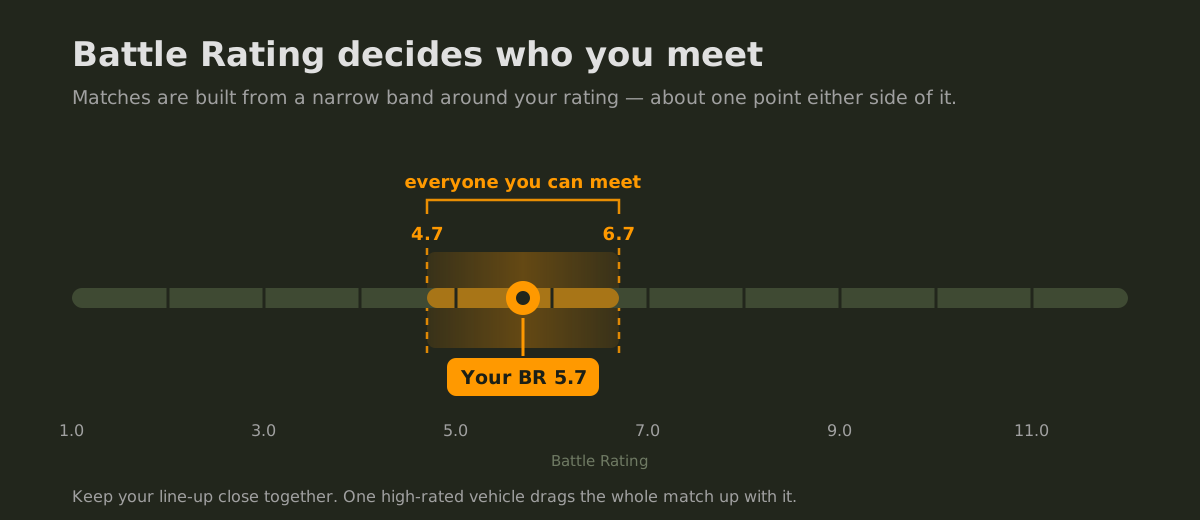
Matchmaking works off Battle Rating (BR). Every vehicle carries a BR, and a match is assembled from vehicles inside a narrow band around it — around one point wide in practice. The practical consequence for a new player: keep the vehicles in your line-up close together in BR. One much higher-rated vehicle drags the whole line-up up into a bracket the rest of it cannot survive.
Coordination matters more than reflexes at first. The game has in-game voice and text chat for your squad, so you can call out positions and cover each other. Plenty of squads use an external voice app instead for longer sessions.
What it costs
The download and the base game cost nothing. There is no subscription requirement to play. What the game does sell, on its own platform, is:
- Premium account time — a multiplier on the research points and currency you earn.
- Premium vehicles and bundles — bought outright, and they also earn at an increased rate.
- Golden Eagles — the paid currency, used for the above and for cosmetic items.
Spending is optional, and it is real money. Prices are set by the publisher and shown on its own store, not here. If the person playing is under 18, make sure purchases are controlled through the platform's parental settings before they start. We do not take payments, and we never see your payment details.
Age rating & safety
War Thunder is an online game depicting military combat, and it carries an age rating. Ratings differ by territory and can be changed by the ratings boards, so check the current PEGI or ESRB rating shown on the official store page for your platform before installing. The game includes online interaction with other players, which is not covered by a content rating.
This website is not directed at children under 16, and we do not knowingly collect personal data from them. See our Privacy Policy.
Getting started
War Thunder is free to download on Windows, Linux and macOS, and on PlayStation and Xbox consoles. (War Thunder Mobile is a separate, standalone game with its own content — it is not the same title.) Create an account, pick a nation and a branch, and play the tutorial before your first Arcade Battle. Stay in Arcade until the controls are second nature, then try Realistic.
Whether the appeal is a tank engine, a dogfight or a gun line at sea, the entry cost is your time rather than your money. Install it, play the tutorial, and find out in an evening whether it is for you.
Partner link. The button below leaves aethervane.online and opens a third-party partner page in a new tab. If you register through it we may be paid a commission, at no extra cost to you. The game itself is free to download; optional purchases are made on the publisher's platform.
How this page was written. This guide is written and maintained by the editorial team at Bacidia s.r.o. from publicly available information about the game. It is independent of the publisher and nobody at the publisher reviewed it. Game content changes with every update, so treat specific numbers as a snapshot of 16 September 2026 and check the official patch notes for current values. Spotted something wrong? Write to info@aethervane.online and we will correct it. More on how we work: About & Editorial Policy.